

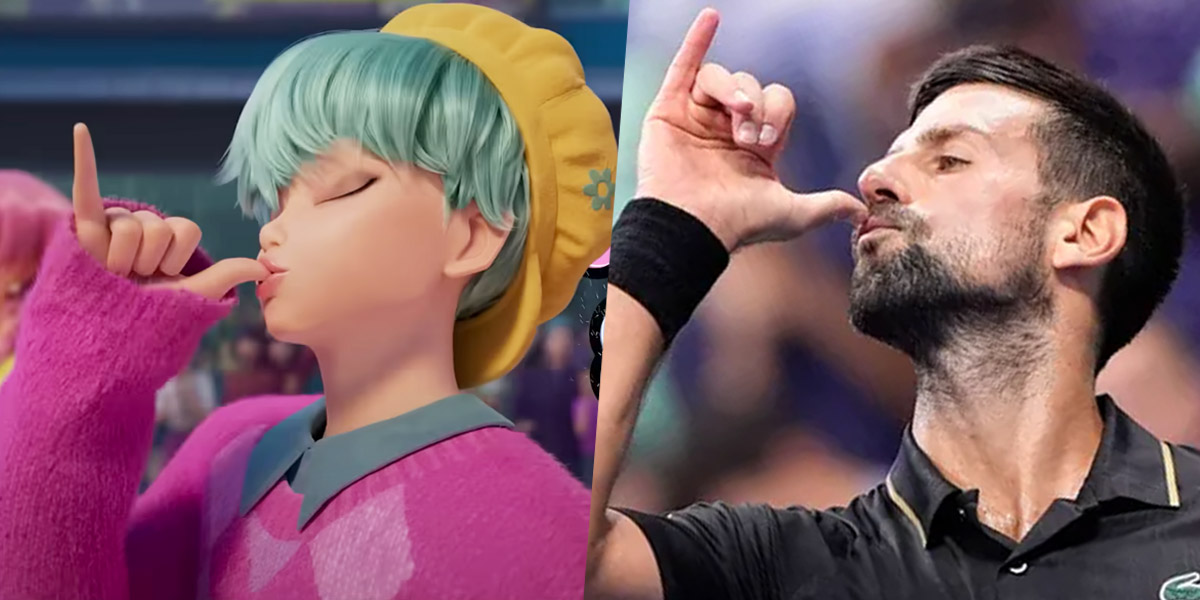
Who knew the US Open would become the newest stage for K-pop? When Novak Djokovic pulled off a “KPop Demon Hunters” dance after his win, the whole world shouted in celebration. Believe us, it was beyond a simple gimmick or parody.
Inspired by his daughter, Djokovic’s K-pop dance captured the joy fans know well — when music, choreography, and heart collide. Because now, Korean hallyu wasn’t just something on your playlist or Netflix charts. Korean hallyu is now owning center court in front of the world
Novak Djokovic “KPop Demon Hunters” Dance: A Heartfelt Gesture
The moment unfolded right after Novak Djokovic’s quarterfinal victory over Taylor Fritz. Instead of the usual fist pumps or a simple bow, the 24-time Grand Slam champion broke into a surprising dance. And not just a regular dance or his own victory routine, but a choreography straight out of “KPop Demon Hunters.”
What’s interesting is that Novak Djokovic learned “KPop Demon Hunters” dance moves from his daughter, Tara. And for the 38-year-old father, this enjoyable dance was a heartfelt birthday gift for Tara who had just turned eight.
“We are at home doing different choreographies, and this is one of them. Hopefully I’ll make her smile when she wakes up in the morning.”
Novak Djokovic
Now think about it. As a fan of Korean Hallyu, you can see just how massive the “KPop Demon Hunters”wave has become. Even though it wasn’t produced in Korea, its story and spirit captured the essence of K-pop so powerfully that it’s now showing up in places no one expected — even on the sacred ground of a tennis court.

That’s how far Hallyu has reached today, and Netflix’s KPop Demon Hunters is one of the key reasons driving that global momentum.
KPop Demon Hunters: From Netflix Charts to Global Arenas
If you’re new to the party, this might make you wonder: why is this such a big deal? Well, to perfectly understand why this moment matters, you have to look at where “KPop Demon Hunters” currently stands.
Released on June 20, the animated film — produced by Sony Pictures Animation but distributed and franchised globally by Netflix — has exploded into a worldwide phenomenon.
According to Netflix’s official data, it recently surpassed “Squid Game” and “Wednesday” to become the platform’s most watched title in history, with over 266 million views and 443 million watch hours within just a few months. And this number is still climbing.
THEIR #1 ERA
— Netflix (@netflix) August 26, 2025
With 236 million views, KPOP DEMON HUNTERS is OFFICIALLY the most popular Netflix film OF ALL TIME. pic.twitter.com/A6yEiXzbHd
The story follows fictional K-pop girl group HUNTR/X, who fight demons while performing music that saves the world. The combination of K-pop aesthetics, fantasy tropes, and sharp animation struck a nerve with global audiences.
Music added fuel to the fire. Its title track “GOLDEN” — performed by EJAE, Audrey Nuna, and REI AMI as HUNTR/X — successfully tops at No. 1 on Billboard’s Global chart and even dominated at #1 of Billboard Top 100 for three weeks as of September 3, 2025. That’s the same tier of achievement BTS reached with “Dynamite” and “Butter.”
And mind you, it’s not just “GOLDEN.” Other “KPop Demon Hunters” songs have also dominated Billboard charts, including “Take Down” and “Soda Pop.”
That is why when Djokovic did that short choreography of “Soda Pop” by “KPop Demon Hunters” villains, Saja Boys, he wasn’t just doing a birthday dance. He was moving to a soundtrack that had already become part of global pop culture — the same way fans everywhere cover it in TikTok videos, create fanart, or cosplay the characters.
Korean Hallyu is Crossing Borders
The “KPop Demon Hunters” dance that Novak Djokovic at this grand tennis competition shows how massive the reach of Korean hallyu today.
Once, K-pop lived in music shows and fan cafés. Then it broke into Billboard, Coachella, and global stadium tours. Now, it’s alive in the most traditional corners of world sport — a match at 2025 U.S. Open Championship in New York.

And this was way far from a forced brand partnership or commercial campaign. This was an eight-year-old teaching her father a dance she loved, and that father carrying it proudly onto one of the biggest courts in the world.
That kind of cultural transfer — intimate, genuine, and unprompted — is the truest sign of Hallyu’s power.
For those of you who have spent years defending K-pop against dismissive claims that it’s “just a trend” or “too niche,” moments like this feel like instant proof. They show how deeply K-culture has rooted itself into daily life across generations, languages, and continents.
What you’ve loved, streamed, practiced, and carried with pride has now danced onto one of the unlikeliest stages — the US Open court — in front of millions watching live and worldwide.
Behind Novak Djokovic “KPop Demon Hunters” Dance
As fans, you’ve probably seen countless outlets replay Djokovic’s jig as nothing more than a funny clip. But look closer, and you’ll notice layers worth holding onto.
Novak Djokovic learned the “KPop Demon Hunters” dance from his daughter, Tara. And this basically mirrors what happens in fandoms everywhere!
Siblings teaching each other routines, best friends learning choreography late at night, or entire communities bonding over a shared performance. As much as it is about music, K-pop has always been about something more profound: human connection.
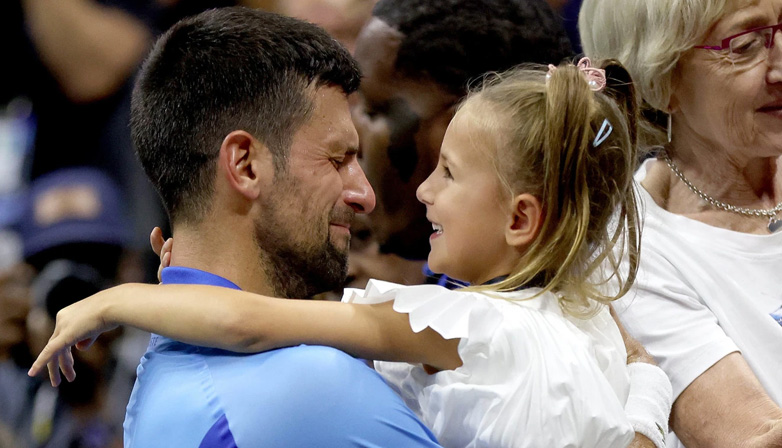
Not only that but the dance also carried emotional language fans know well. It was a quiet message of affection, unfolded on a stage no one expected, which let’s just admit it, both shocking and striking.
Again, a tennis court—and a U.S. Open Championship, for that matter—isn’t where you imagine a K-pop dance challenge. And that is why this pretty much shows that Korean hallyu is no longer just a visitor in global culture — it has become part of the household, woven into everyday life across the world.
The Deeper Cultural Shift of Korean Hallyu
Think about this for a second: “KPop Demon Hunters” wasn’t even produced in Korea. Sony Pictures Animation created it, and Netflix now holds the global distribution and merchandising rights. The irony is almost painful — a film built on the heartbeat of K-pop has become one of the biggest cultural touchpoints of 2025, yet the intellectual property doesn’t even belong to South Korea.
And yet, that’s also the most revealing truth about the power of Korean hallyu. Even when outsiders package it, even when the rights sit in Hollywood boardrooms, the spirit that drives K-pop and K-dramas is so magnetic it cannot be contained.
What you’re really seeing is proof that K-culture has grown too big for borders, and too strong to be limited by ownership.
Novak Djokovic’s dance completes that cycle. A Serbian tennis legend, celebrating with a choreography inspired by a Korean cultural export reimagined through American production and global streaming.
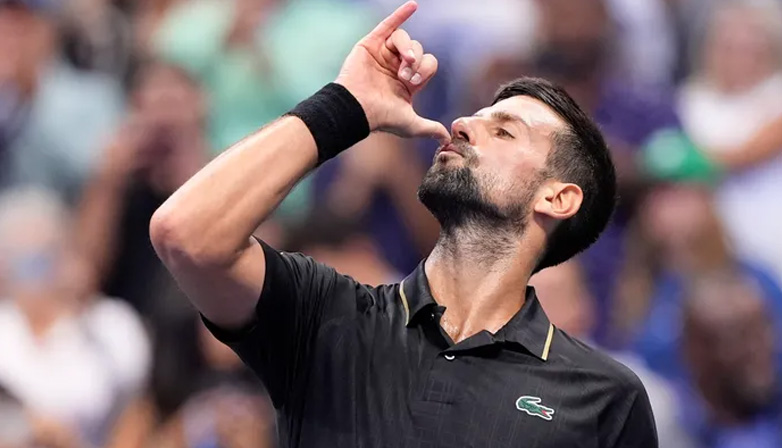
That’s the world K-pop has built: a borderless cultural wave that adapts and resonates wherever it arrives.
When K-Pop Dances Beyond Its Stage
Yes, Djokovic’s dance was short, even clumsy compared to polished idol routines. But you didn’t need precision to feel the meaning.
What you saw was exactly what K-pop gives you in your own life: joy, connection, and the thrill of carrying music into spaces where it doesn’t “belong,” until it suddenly does.
So when people ask what makes Hallyu different, point them to this moment.
It’s the proof that Korean hallyu wave no longer needs a stage, a lightstick, or a fan chant to live. It can thrive in a tennis arena, carried by the hands of a father for his daughter, and celebrated by millions of fans who know the language of dance by heart.
Because once K-pop moves you, it never stops moving the world.
Don’t you think so too? Please share your thoughts in the comments.
Join us on Kpoppost’s Instagram, Threads, Facebook, X, Telegram channel, WhatsApp Channel and Discord server for discussions. And follow Kpoppost’s Google News for more Korean entertainment news and updates.